
Wasp Nest Removal & Hornet Control in Bellingham & Whatcom County
Colonies here peak in late August and September, which is when nearly all the stings happen. We remove ground nests, aerial nests and the wall-void nests that are genuinely dangerous to attempt yourself. If you have a nest near a door, a walkway or a play area, that moves to the front of our schedule.
Call 360-410-2199 Request a free inspection

Wasps: the job at a glance
| What it covers | Yellowjacket, bald-faced hornet and paper wasp nests in the ground, in the open and inside walls |
|---|---|
| Included | Finding the nest, treating it early or at dusk, taking down accessible nests, and sealing the entrance once the colony is dead |
| Not included | Killing honey bees; a swarm goes to a beekeeper and a wall colony is a removal and repair job |
| Priority | Nests near a door, a walkway or a play area move to the front of the schedule |
| Return visit | A wall-void colony that is still active gets a second visit under our 100% Service Guarantee |
| What it costs | Free estimate given before work starts; height, access and wall voids raise the price |
The late-summer problem
Almost every wasp sting in Whatcom County happens in a six-week window, and understanding why makes the whole season predictable.
A yellowjacket or hornet colony is annual. It starts in spring with a single overwintered queen building a nest the size of a golf ball and raising the first few workers herself. Through summer those workers take over and the colony compounds. By late August a western yellowjacket nest that was invisible in June can hold thousands of individuals, and the colony is at maximum size, maximum defensiveness and maximum food demand all at once.
At the same time, for one group of them, the diet flips. Early in the season workers hunt insects and spiders to feed protein to developing larvae — which makes them genuinely useful in a garden and is why we do not treat every nest we see. Late in the season brood production winds down, the larvae that were feeding the adults sugar stop, and the workers go looking for carbohydrate elsewhere. That is why the wasps that ignored you at a June barbecue are in your drink in September.
That flip is not universal, and knowing which insects it applies to saves people money every year. UC IPM separates the ground- and cavity-nesting yellowjackets in the genus Vespula from the aerial nesters in Dolichovespula — the bald-faced hornet and the aerial yellowjacket — and only the first group turns scavenger. The aerial species stay predatory right through to the death of the colony, hunting flies and caterpillars in September exactly as they did in June.
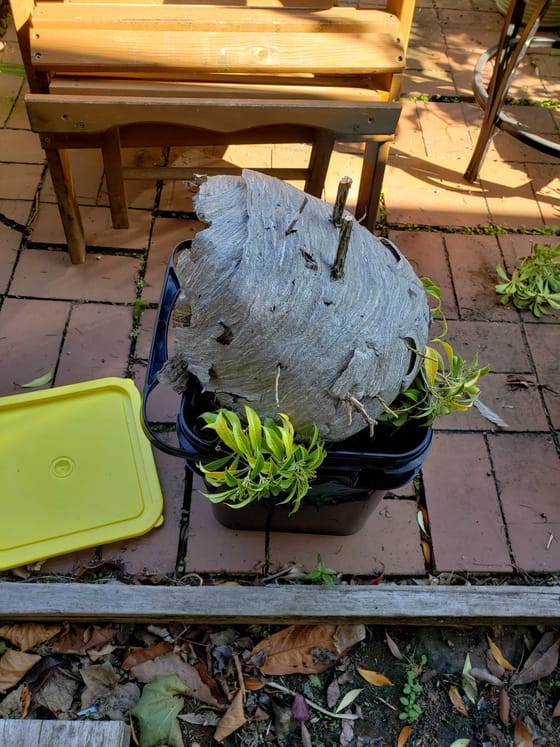
That distinction pays for itself immediately. The black-and-white insect with the football-shaped gray nest in the maple is essentially never the one walking around a plate at a September picnic table, and neither is an open-comb paper wasp under the eaves. Something is at the table, but it is coming from a hole in a bank, a rodent burrow or a gap in the siding that nobody has found yet. Treating the visible aerial nest because it is the one you can point at deals with the wrong colony, costs money and changes nothing about the table. When somebody calls us about wasps at an outdoor eating area, the first job is working out where they are actually flying home to.
Then the first hard frost kills the colony outright. Only newly mated queens survive, overwintering under bark, in leaf litter or in structures, to start over in spring.
Two practical consequences follow. First, a nest found in September is a much bigger and more defensive job than the same nest in June, which is why we say that if you saw a nest last year in a particular spot, the cheap time to act is early. Second, an old yellowjacket nest is not a future colony: WSU bulletin EB0643 records that abandoned nests decompose over the winter and are not used again. That rule holds without qualification for every yellowjacket and hornet on this list. It has exactly one local exception, which is covered below.
What we actually have here
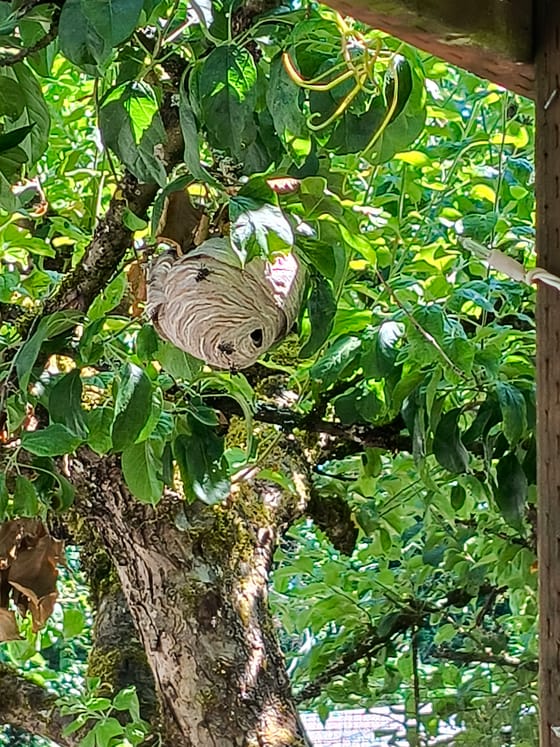
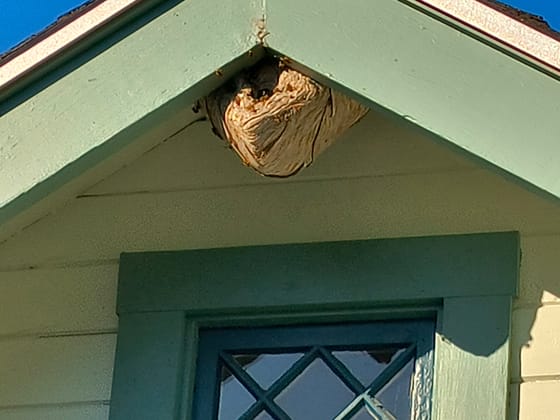
Bald-faced hornet. Despite the name this is a yellowjacket, not a true hornet. Large, black and ivory-white, and it builds the football-shaped gray paper nest people photograph — hanging from a branch, a soffit, a shrub or occasionally a wall. Genuinely defensive within several feet of the nest. This is also the insect most often reported to us as a giant hornet.
Aerial yellowjacket. Similar enclosed paper nests in shrubs, trees and under eaves, smaller and yellow-marked.
Western yellowjacket. The ground nester, and the one responsible for most stings in this county. It nests in abandoned rodent burrows, under root balls, in retaining walls and in landscape voids — meaning the nest is invisible until someone runs a mower over it or steps on the entrance. Aggressive when disturbed, and highly attracted to food and drink in late summer.
German yellowjacket. Introduced, and notable because it readily nests inside structures — wall voids, attics and soffits — rather than in the ground. When we get a wall-void call, this is often what it is.
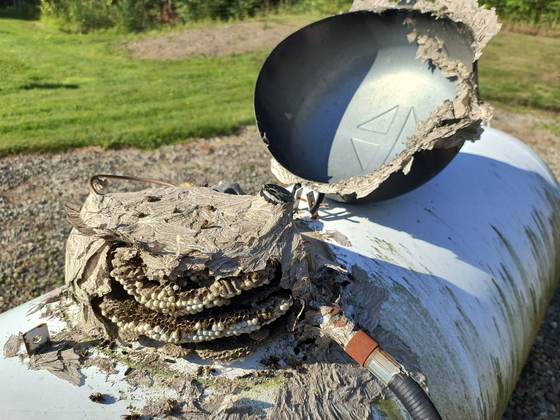
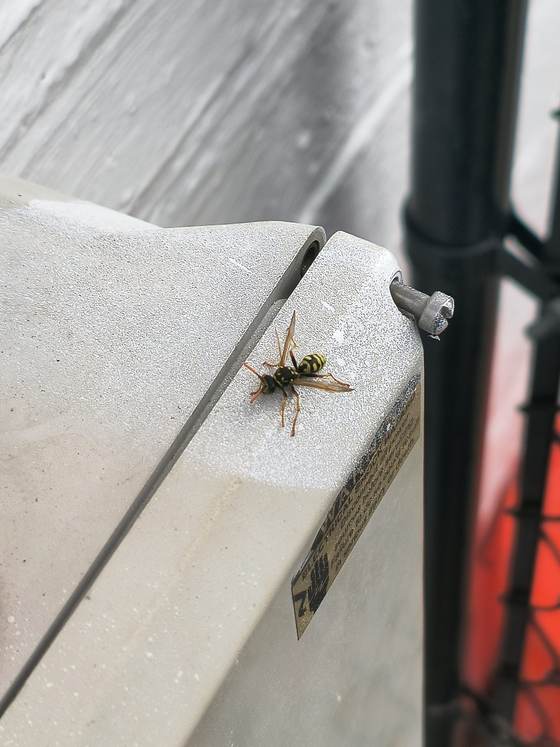
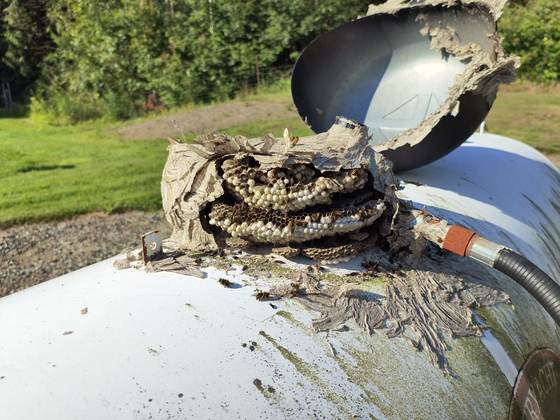
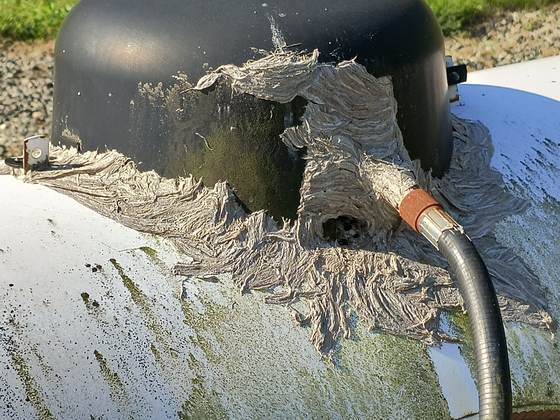
European paper wasp. Now common across the Pacific Northwest. Slimmer, longer legs trailing in flight, and easily confused with a yellowjacket by coloring. It builds the open, umbrella-shaped comb with visible cells rather than an enclosed paper envelope, and it nests in small cavities constantly — under eaves, in mailboxes, in gas grills, in pipe ends, in patio furniture tubing. Far less defensive than a yellowjacket.
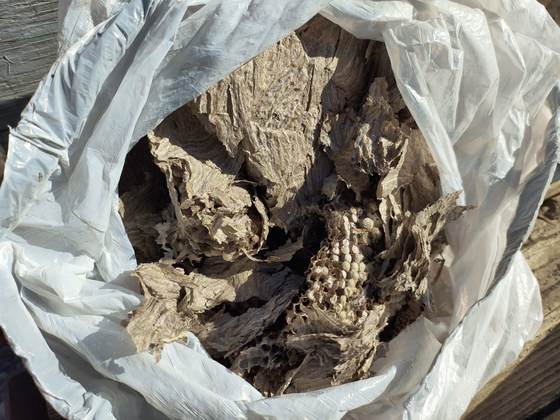
This is also the exception to the single-use rule above. Penn State records queens of this species founding colonies earlier than the natives partly by taking over the previous year’s structure, and WSU PestSense puts it as queens occasionally reusing old structures although they typically build new ones. The colony still dies in autumn; the paper is what persists, and a comb left in a sheltered cavity can give next April’s queen a running start. Clearing old combs out of grills, pipe ends and furniture tubing over winter is the cheapest thing anybody can do about this wasp, and it involves no treatment at all.
Whether it is pushing our native paper wasps out is genuinely unsettled, and we would rather say so than pick the more dramatic version. Penn State reports evidence of an adverse impact on native Polistes. Colorado State Extension, looking at its own state, says there is no evidence of a significant effect on the natives there. Both are extension entomology sources and they do not agree, so the honest summary is that the introduced wasp has spread fast and that the case against it is suggestive rather than settled.
Native paper wasps. Same open comb, browner, generally placid. We frequently leave them alone when the location allows it.
About the northern giant hornet
This deserves its own section here, because Whatcom County is where it actually happened and the local memory of it is genuine.
The species now called the northern giant hornet — earlier widely reported as the “murder hornet” — was first confirmed in Washington State in late 2019, and the detections were here. Four nests were located and eradicated in Whatcom County between 2020 and 2021, in the Blaine and Custer area. After three years with no confirmed detections, state and federal agriculture officials announced in December 2024 that the species had been eradicated from the United States.
So the honest position is this. It was real, it was here, it was taken seriously, and it was successfully eliminated. It is not something we expect to find on your property in 2026.
In practice, essentially every report we receive turns out to be a bald-faced hornet — large, black and white and startling — or an elm sawfly, which is a harmless wood wasp that looks alarming and is not a hornet at all.
If you do genuinely believe you have seen one, report it to the Washington State Department of Agriculture rather than to us. Agencies still want sightings, and a photograph is worth far more than a description. What you should not do is poison something you cannot identify on the assumption it might be one.
Where the nest is decides the job
Ground nests. Western yellowjacket, entrance often no bigger than a coin, usually found by accident. Dangerous specifically because they are invisible and because mowing or digging provokes a mass response. Treatment goes into the entrance and the colony traffic does the rest, but it has to be done properly and at the right time of day.
Aerial nests. Bald-faced hornet and aerial yellowjacket. The visible ones. Height and access set the difficulty, and the risk is largely about what happens to a person on a ladder who gets stung.
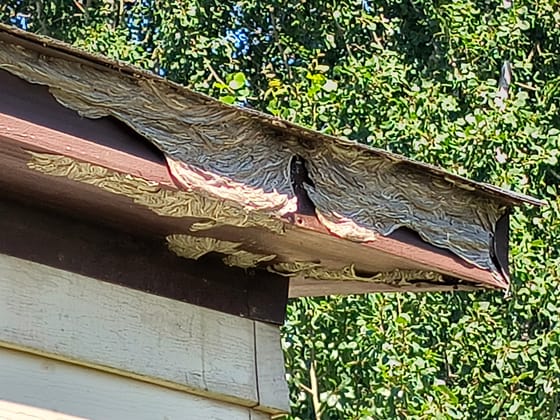
Open comb. Paper wasps under eaves, in grills, in furniture tubing. Straightforward, and frequently there are several small nests around a property rather than one large one.
Wall voids and attics. The one that genuinely needs a professional. A colony inside a structure enters through a small exterior gap — a gap in siding, a vent, a utility penetration — and builds in the cavity. Two things make this different. The nest is not accessible from outside, so treatment has to reach a space you cannot see. And the failure mode is severe: if the exterior entrance is sealed while the colony is alive, the wasps chew laterally looking for another way out, and the path of least resistance is frequently drywall. People seal a hole in their siding and then have wasps in the bedroom.
Never seal a wall-void nest. Treat it, confirm it is dead, then seal.
Safety, said plainly
Wasps sting repeatedly — unlike honey bees they do not lose the sting — and a disturbed colony will pursue. A yellowjacket ground nest hit by a lawnmower can deliver dozens of stings in seconds.
The risks worth taking seriously are three. Allergic reaction, which for someone with a known sting allergy is a medical emergency and a reason not to go anywhere near the nest. Sting volume, because even without allergy, a large number of stings is a genuine medical event. And the ladder, which is underrated — a significant share of serious wasp injuries are falls by someone who got stung at height rather than the stings themselves.
Add to that the fact that yellowjackets are most defensive in exactly the season when people are most likely to find them, and it is why we would rather you call than climb.
If someone in the household carries an epinephrine auto-injector for stings, tell us when you call. It changes how we schedule and how we work the site.
What about bees?
We do not kill honey bees, and we will tell you when what you have is bees rather than wasps.
A honey bee swarm — a hanging cluster on a branch or fence, often thousands of bees, usually gone within a day or two — is a colony in transit. It is generally not aggressive, and local beekeepers will frequently collect one at no charge. That is the right outcome and we will point you toward it.
An established honey bee colony inside a structure is a different matter. That is comb, brood and honey inside a wall, and resolving it properly means opening the cavity, removing the colony and the comb, and repairing — because abandoned comb melts, stains and attracts secondary pests. It is a removal and repair job rather than a pest treatment, and we will be straight with you about what it involves.
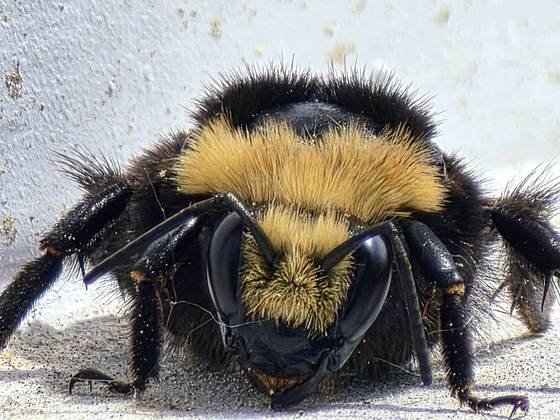
Bumble bees nest in small colonies in ground cavities and insulation, they are important pollinators, and they are rarely worth treating. Where a nest is in a genuinely bad location we will discuss it, but the default answer is to leave them.
The insects that get mistaken for bees most often are the European paper wasp and various hoverflies, which are harmless mimics.
How we work a wasp job
Identify and locate. Species and nest type change the method entirely, and a surprising number of calls turn out to involve two nests rather than one. Where the entrance is a gap in siding we want to know what is behind it before we treat.
Time it. Wasp work is best done when the colony is home and least active — early morning or dusk — rather than in the middle of a warm afternoon with half the workers out foraging. Treating at the wrong hour leaves a returning population with nowhere to go and no colony to return to, which is worse for everyone.
Treat the nest, not the wasps. The objective is the colony, delivered at the entrance or into the void, not a knockdown of whatever is flying.
Remove where it makes sense. Accessible aerial nests come down once the colony is dead. Wall-void nests sometimes stay in place, because opening a wall to extract paper is not always worth doing — but the entrance is sealed afterward, and only afterward.
Seal, so it does not recur. The gap that let a colony into your wall will let another one in next spring. Closing it is the part that lasts, and it usually belongs with our exclusion and repair work.
Come back if it is still active. A wall-void colony occasionally needs a second visit, and that is covered under our 100% Service Guarantee.
Around the county
Older Bellingham neighborhoods — Lettered Streets, Columbia, Sunnyland, York, Roosevelt. A century of siding, trim and utility penetrations means more cavity entrances than newer stock, and German yellowjackets in wall voids are common.
The newer hillside developments — Alabama Hill, Barkley, Cordata, King Mountain. Soffits, deck framing and open eaves. More aerial and paper wasp work.
Rural and agricultural — Lynden, Everson, Nooksack, Sumas. Outbuildings, equipment, stacked material and open structures. High volume, and yellowjackets around livestock and fruit are a working nuisance rather than an occasional one.
The lake and forest margins. In Sudden Valley, Silver Beach and Edgemoor it is ground nesting in banks and root balls, and property where people are outdoors in exactly the places the nests are.
Waterfront — Blaine, Birch Bay and Semiahmoo. Decks, sheds and seasonal homes where a colony can build all summer with nobody there to notice.
Commercial wasp work
Late-summer wasp pressure is a scheduling problem for commercial sites rather than an emergency, and it is one of the few pest issues where the calendar is predictable enough to plan around.
Food service and outdoor dining. Yellowjackets at patio tables in late August are a customer experience problem and occasionally a liability one. The work that matters happens in spring — removing founding nests before they establish — plus waste handling and bin placement through the season.
Schools and childcare. Ground nests in playing fields and playground margins, and paper wasp nests in covered walkways and equipment. These sites carry notification requirements under Washington law for pesticide application, and they are also the sites where the sting risk lands on children, so we inspect on a cycle rather than waiting for a report.
Agriculture. Yellowjackets around fruit, livestock and equipment through harvest are a working hazard for the people who have to be there. Volume is higher and the nests are frequently in stacked material and outbuildings.
Marinas and waterfront. Covered moorage, sheds and boat storage give sheltered nest sites, and the people who encounter them are usually on a dock or a ladder.
Property management and HOAs. Wall-void colonies in multifamily buildings are the recurring one, because an entrance gap in shared siding serves the building rather than a unit, and residents report it late.
For all of these the useful arrangement is a spring sweep plus response during the season, which is part of our commercial programs.
Reducing them next year
The highest-value intervention is in spring, and almost nobody does it. In April and May a founding queen is building alone, the nest is tiny, and the whole colony is one insect. Knocking down small starter nests under eaves and in sheltered corners at that stage prevents the September problem entirely, and it carries almost no risk.
Beyond that: keep bins closed and rinsed, deal with fallen fruit, cover food and drink outdoors in late summer, seal gaps in siding, screen vents, plug open pipe ends and check the inside of gas grills and patio furniture tubing before the season. Fill abandoned rodent burrows, which are where western yellowjackets most often set up.
And a note on traps — commercial lure traps catch foragers, which reduces nuisance around a specific area, but they do not eliminate a colony. They are a comfort measure for a deck, not a control method.
What it costs
Wasp work is quoted from what the nest is and where it sits, and the range is narrower than most of our services because the job is usually bounded.
An accessible paper wasp comb under an eave is a small job. A ground nest in an open lawn is straightforward. What raises the number is height and access — a bald-faced hornet nest at the top of a two-story gable needs different equipment from one in a shrub — and wall-void colonies, which take longer, sometimes need a return visit to confirm, and should be followed by sealing the entrance.
Several nests on one property is common and is usually cheaper per nest than calling three times through the season, which is another argument for dealing with a property in one visit rather than reacting nest by nest.
You get the figure before work starts, and the estimate is free. If we get there and find the nest is inactive — which happens, particularly late in the season after a cold snap — we will tell you that rather than treating an empty nest.
What to do right now, if there is a nest
If it is not in anyone’s way, the honest answer is often to leave it. A bald-faced hornet nest high in a tree at the back of a lot is doing no harm and will be dead by December. Paper wasps under a shed eave are useful predators.
If it is in the way, keep people away from the immediate area and call. Do not knock it down, do not spray it with a hose, and do not attempt an aerial nest from a ladder. Wasps defend a radius around the nest rather than the nest itself, so the mistake people make is getting close enough to be inside that radius while holding something that requires both hands.
If someone has been stung multiple times, or has any difficulty breathing, swelling away from the sting site, or a known sting allergy, that is a medical call rather than a pest control one. Make it first.
If the nest is in a wall, note where the insects are entering and leave it completely alone until we get there.
Related work
Wasp jobs regularly reveal the gap that let the colony in, which is exclusion and repair work. If what you have under the eaves turns out to be a wood-boring bee rather than a wasp, that is wood-boring bee and beetle control. And for commercial sites — schools, food handling, marinas — late-summer wasp pressure is usually best handled on a scheduled basis rather than reactively, which is part of our commercial programs.
Frequently asked questions
Why are wasps suddenly everywhere in late summer?
A colony starts with one queen in spring and grows all season, so August and September is simply when it is largest. The diet shift belongs to the Vespula yellowjackets — the ground and wall nesters — which swap hunting insects for sugar and meat as brood rearing winds down. UC IPM records that the aerial nesters in the genus Dolichovespula, meaning the bald-faced hornet and the aerial yellowjacket, stay predatory to the end and never make that switch.
Should I plug the hole where they are going into my siding?
No, and this is the one that causes real damage. A blocked colony does not give up and leave — it chews an alternative exit, and that exit is frequently into the wall cavity and then into the room. Sealing a wall-void nest is how people end up with wasps inside the house.
Do wasp nests get reused the following year?
For yellowjackets, no — WSU bulletin EB0643 states that the abandoned nests decompose over the winter and are not used again. The colony dies at first frost and only newly mated queens survive, starting fresh elsewhere in spring. The European paper wasp is the local exception: Penn State records queens founding colonies early by taking over the previous year's structure, and WSU PestSense says queens occasionally reuse old ones. The colony still dies either way, but the paper can outlast it.
Is that a northern giant hornet?
Almost certainly not. Whatcom County was the site of the only US detections, and after four nests were eradicated here between 2020 and 2021, state and federal agencies declared the species eradicated in December 2024. Nearly every report we get is a bald-faced hornet or an elm sawfly. If you genuinely believe you have one, report it to WSDA — they still want to know.
Can you remove a honey bee swarm?
We do not kill honey bees. A swarm hanging in the open is usually temporary and a local beekeeper will often collect it free. An established colony inside a wall is a removal-and-repair job rather than a pest treatment, and we will tell you honestly which one you have.
How fast can you get here?
Wasp work near a doorway, a walkway or where children play is the one thing we routinely move ahead of other jobs, because the risk is immediate rather than gradual. Call or text and tell us where the nest is relative to how people move around the property.
Guides
Wasps, hornets and bees: 11 photographs from real jobs
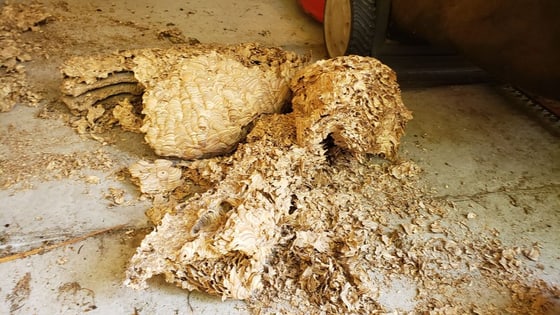
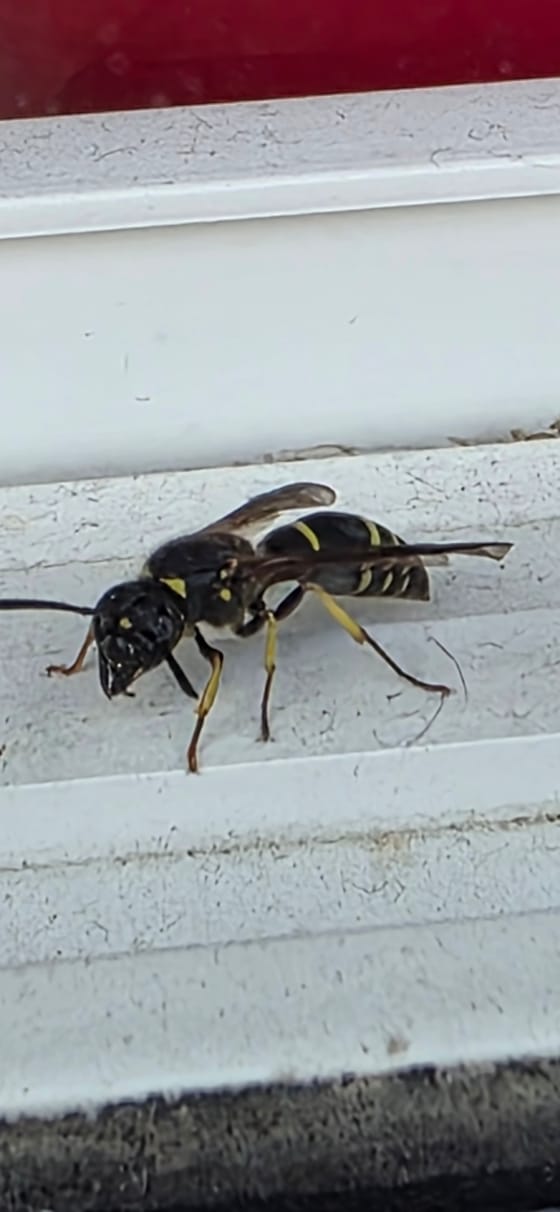
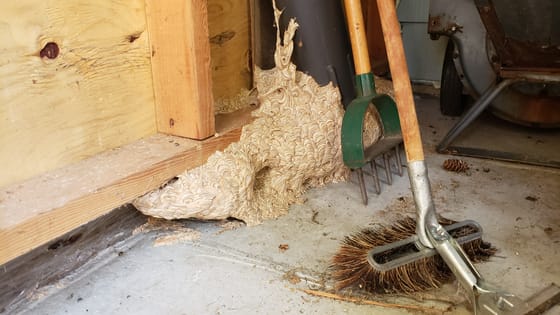
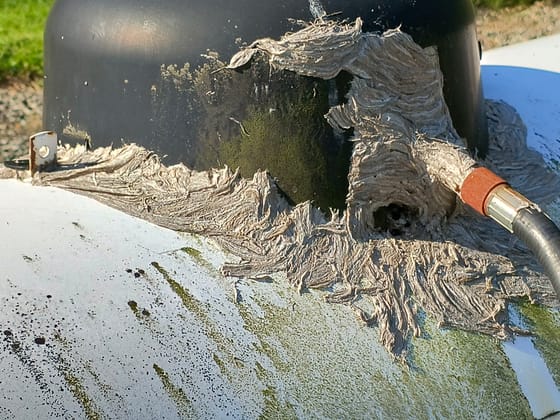
Every one of these was taken on a job in Whatcom or Skagit County by whoever was doing the work. Stock photography is close to universal in this trade and a reader has no way to tell by looking, which is the only reason it is worth saying out loud. The rest of the archive is on the gallery.

From the blog
Wasp & Hornet Control in Whatcom County?
Family-owned, no long-term contracts, and every treatment is backed by our 100% Service Guarantee.
Most calls in Whatcom County are out within 1–2 days, about 3 during the late-summer peak.
Last updated