
Ant & Carpenter Ant Control in Bellingham & Whatcom County
Odorous house ants are the ant most homes here actually have, and the one a hardware-store spray makes worse — repellents split the colony rather than killing it. Carpenter ants are about three calls in ten and are what damages the building. Moisture ants mean water. Identification decides the treatment, because the three want different work.
Call 360-410-2199 Request a free inspection

Ants, on video

Ants: the job at a glance
| What it covers | Odorous house ants, carpenter ants and moisture ants, identified to species before anything is treated |
|---|---|
| Included | Finding the nest, non-repellent products and baits, correcting conditions, sealing entry routes and follow-up checks |
| Not included | Fixing the failed gutter or leaking supply line behind moisture ants, which is another trade |
| How long it takes | Weeks rather than days for carpenter ants; two to three weeks for odorous house ants |
| Before we arrive | Leave the ant trail alone and do not spray it; we follow it to the nest |
| What it costs | Free estimate, with the figure in writing before work starts |
Three ants, and only one of them eats your house
More money is wasted on ant treatment in this county than on any other pest, and almost all of it comes down to one mistake: treating the ant you can see instead of identifying which ant it is.
Roughly, and from our own call volume rather than from a textbook:
Odorous house ants lead, and it is not close. This is the ant most homes here actually have. It does no structural damage at all, which is exactly why people treat it themselves — and it is the one species where doing that makes things worse rather than merely failing. Repellent sprays cause the colony to bud: it fragments and relocates instead of dying, and one nest becomes three or four. A great many of the ant jobs we are called to are jobs somebody has already made harder.
Carpenter ants are about three calls in ten, and they are the species that matters structurally. They excavate galleries, maintain satellite colonies inside buildings, and the work is finding the nest rather than killing the trail.
Moisture ants are fewer again — a small share of the year — and they are not really a pest problem at all. They are an indicator. They only nest in wood that is already wet, so finding them inside a wall means water has been getting into that wall long enough to soften it. Correct the water and they leave on their own, because the thing that made the site habitable is gone.
Those three want different work, and one of them wants the opposite of what the bottle under the sink does. That is why we will not quote ant work over the phone from a description of “small black ants.”
Odorous house ants
Odorous house ant (Tapinoma sessile). Small, dark brown, and unmistakable once you know it — crushed workers smell strongly of coconut or blue cheese. Nests indoors and out, often in wall voids, under floors, or beneath objects on the ground. The important thing about this species is the budding described above: it is the ant that most often gets worse after somebody treats it from a hardware-store bottle. It requires baiting and patience, and patience is the part people are not warned about — a bait working properly still looks like nothing is happening for the first week.
Carpenter ants
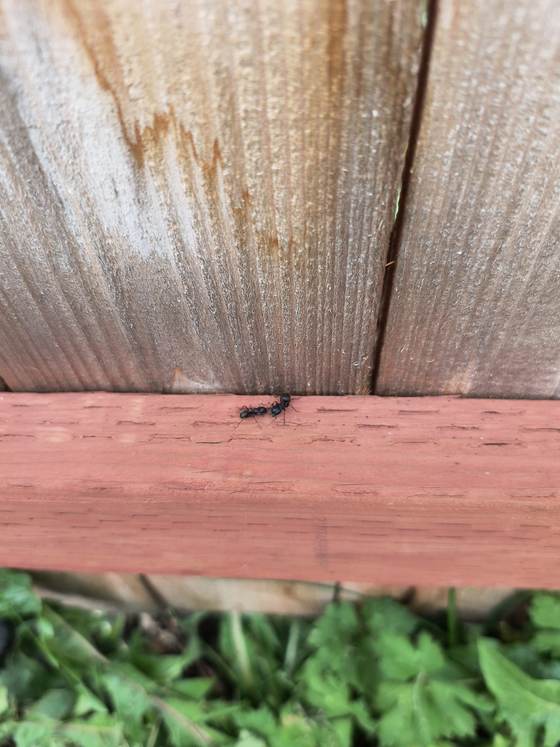
What they are. Camponotus modoc is the common one here — large, matte black, workers ranging from about a quarter to over half an inch in the same colony, because carpenter ants are polymorphic. That size variation is a useful field mark. A single evenly-sized column of ants is probably not carpenter ants.
They do not eat wood. This is the most common misconception and it changes the strategy. Carpenter ants chew wood to excavate galleries and push the shavings out as waste. They feed on other insects, honeydew and sugars, which is exactly why baiting works — a worker will carry a sugar bait back and share it through the colony, which a wood-eating insect would never do.
Parent and satellite colonies. This is the part that defeats most do-it-yourself treatment and a fair amount of professional treatment too. A carpenter ant colony is not one nest. There is a parent colony containing the queen and the brood, which needs consistent moisture and is very often outdoors — a stump, a fallen log, a standing dead tree, a woodpile, a landscape timber. Radiating from it are satellite colonies containing workers and older larvae, which tolerate drier conditions and are quite happy inside your wall void, your attic, your door frame, or the void behind a bathtub. UC IPM describes the same two-part arrangement — a parent nest holding the queen and the brood, with satellite nests of workers and older larvae that get by in drier wood — which is why locating one nest is not the same as locating the colony.
Kill a satellite and the parent replaces it. Spray a trail and you have removed foragers the colony can afford to lose. The only treatment that ends it is one that gets back to the queen, which is why we use non-repellent products and baits designed to be carried rather than contact killers designed to knock down what you can see.
Foraging distance is part of why this is hard: a hundred yards between the parent colony and the building is unremarkable, and workers cover it along fence lines, utility wires and branch contact rather than across open lawn. The stump that matters is sometimes on the neighboring lot.
The winter tell. Foraging carpenter ants outdoors in summer are normal and frequently not worth treating. Large ants walking across your kitchen floor in January are a different signal entirely — they are not commuting from a stump in midwinter. Winter activity indoors means a satellite colony is already in the structure, and that is worth acting on.
Frass. Carpenter ants push their excavation waste out of slit-like openings, producing small piles of what looks like coarse sawdust. Real frass is fibrous and shredded rather than powdery, and it usually contains insect body parts — legs, wing fragments, bits of the colony’s prey. That last detail is the reliable way to tell it from drill dust left by a contractor. If you find it, leave it where it is. It marks the gallery, and sweeping it up removes the best evidence we have about where to open the wall.
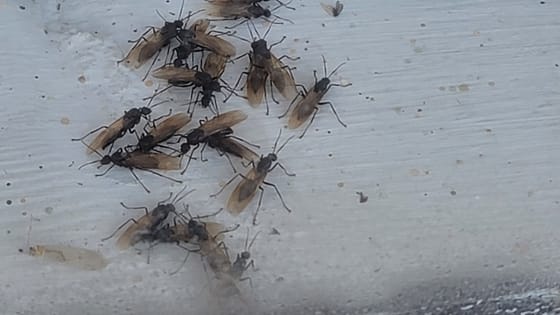
Swarmers. Winged reproductives appear in spring here, generally March through May. Finding them inside the house is significant — it means a mature colony, at least a couple of years established, is inside the structure rather than outside it. Winged ants at a window in April are among the clearest signals in this business.
Moisture ants
What they are. Several Lasius species, smaller than carpenter ants, and usually yellowish to light brown rather than black. Some produce a distinctly citrus or lemony smell when crushed.
What they mean. Moisture ants excavate only wood that is already water-damaged and beginning to decay. They cannot establish in sound dry lumber. So their presence inside a structure is diagnostic: there is, or has recently been, a persistent water source in that location.
In practice, when we find moisture ants in a Whatcom County house, the real finding is almost always one of a short list. A failed or overflowing gutter running down a wall. A downspout discharging against the foundation. A crawlspace with no functioning vapor barrier and standing groundwater. Bathroom or kitchen plumbing leaking slowly inside a wall. A deck ledger board flashed badly or not flashed at all. Siding that has been in contact with soil or bark mulch for years. Window flashing that failed a decade ago.
Why this is good news, mostly. Moisture ants themselves do very little structural damage — the wood they occupy was already compromised. The bad news is what they are pointing at, because a wall wet enough to support them has usually also been supporting decay fungus, and that is a repair conversation rather than a pest conversation.
We will tell you when the person you actually need is a contractor. That sometimes costs us the treatment, and it is the right call.
The others you will meet here
Pavement ant. Small, dark, characteristically nesting under slabs, driveways, walkways and against foundations, throwing up small soil craters at cracks and expansion joints. Mostly an outdoor nuisance that comes inside to forage.
Velvety tree ant. Sometimes confused with carpenter ants — dark head, reddish mid-section, black abdomen, and a strong odor when crushed. Nests in trees and in damp structural wood, and can be aggressive.
Thatching and field ants. Common outdoors on rural and forest-edge property. Rarely a structural concern, occasionally a yard one.
Why the hardware-store approach usually fails
Three reasons, and they are worth understanding because they explain most of what people have already tried before calling us.
Repellent products scatter the colony. Most consumer sprays are contact killers and repellents. They kill the ants they touch and warn everything else away from the treated surface. Against a budding species like the odorous house ant that is actively counterproductive.
Killing foragers does nothing. The ants you see are a small percentage of the colony and the most expendable part of it. A colony that loses its foragers sends more.
The trail is destroyed. This is the practical one. That line of ants across your counter is a chemical trail leading somewhere, and following it is how we find a nest without opening walls at random. Spraying it removes our best diagnostic tool for a day of temporary relief.
So the single most useful thing you can do before we arrive is leave the trail alone. Clean up the food source, by all means. Do not treat the ants.
How we work an ant job
Identify. Under magnification where it matters. Everything downstream depends on this, and it takes minutes.
Find the nest. Trail following, moisture readings, sounding suspect wood, and inspecting the places these species actually nest — sill plates, rim joists, crawlspaces, wall voids around windows and doors, subfloor beneath bathrooms and kitchens, attic sheathing, and outdoors, the stumps, woodpiles and landscape timbers within foraging distance of the house.
Treat to reach the colony. Non-repellent products the ants walk through and carry, plus baits matched to the species and the season, because these species shift between sugar and protein preference through the year. Applied where the colony travels rather than broadcast across surfaces.
Correct the conditions. Where moisture ants are involved this is the actual treatment. Where carpenter ants are involved it is what stops the next colony — removing the stump, moving the woodpile off the foundation, cutting the branch that bridges to the roof.
Exclude. Sealing the entry routes, which on Whatcom County housing tends to mean around utility penetrations, window and door framing, and where siding meets foundation.
Follow up. Decline runs in weeks rather than days, and activity often increases briefly first as the bait circulates. We do not publish a fixed number of weeks for carpenter ants, because no extension source we can point to gives one, and colony size, satellite count, nest location and how much material actually reaches the brood all move the answer on a given house. Odorous house ants are the species where the two-to-three-week figure is well attested, and that is a different insect with a different nest structure. So we check rather than assume, and we would rather revisit a property than quote you a schedule we cannot stand behind.
Around the county
Prewar Bellingham — Lettered Streets, Columbia, Sunnyland, York, Roosevelt, South Hill. Post-and-pier foundations, sill plates close to grade, and a century of gutter and flashing history. This is moisture ant country, and the finding is usually water rather than ants.
The Lake Whatcom shoreline. Sudden Valley, Silver Beach and Edgemoor. 1970s cedar construction against a working forest edge, with plenty of stumps and standing dead wood for parent colonies. Classic carpenter ant territory, and the satellite colonies come inside.
Newer hillside — Alabama Hill, Barkley, Cordata, King Mountain. Landscaping held tight against foundations, bark mulch above the siding line, and irrigation keeping it damp. More often a perimeter and conditions job than a structural one.
Rural and agricultural — Lynden, Everson, Nooksack, Sumas, and the unincorporated country between. Outbuildings, stacked lumber, field margins, and more species diversity including field and thatching ants.
Waterfront — Blaine, Birch Bay and Semiahmoo. Salt air is hard on flashing and fasteners, and second homes sitting empty mean small leaks run for months before anyone notices. Moisture ants again.
What the damage looks like over time
Carpenter ants work slowly. A satellite colony is not going to bring a wall down in a season, and anyone telling you otherwise is selling urgency. What they do over years is hollow structural members along the grain — sill plates, headers, studs around windows, joists near a chronically damp area — and because they prefer wood that is already slightly softened, they compound an existing decay problem rather than starting a new one.
The practical consequence is that a colony left for five or six years in a chronically wet wall turns a pest bill into a carpentry bill. That is the argument for dealing with it, and it is an honest one.
What it costs
We quote from an inspection. A single accessible satellite colony in a door frame is a small job. A house with a parent colony in the yard, two satellites in the structure, and a moisture source feeding both is a larger one, and where the finding is a failed gutter or a leaking supply line, part of the fix is somebody else’s trade.
You get the figure in writing before work starts, and the estimate is free. If the honest answer is that you need a contractor more than you need us, that is what the estimate will say.
The ant year in Whatcom County
Ant activity here follows a predictable arc, and knowing where you are in it tells you a lot about what you are looking at.
February and March. Colonies come out of winter dormancy as soil temperatures rise. First indoor sightings of the year, usually foragers testing routes. Early activity in a house that had ants last year is worth acting on rather than waiting to see.
March through May. Carpenter ant swarming season. Winged reproductives appear, and this is the diagnostic window — swarmers found indoors mean a mature colony inside the structure, not a nest in the yard. It is also when moisture ant activity shows up most clearly, because the wet season has just finished doing its work on any wall that leaks.
June through August. Peak foraging. This is when most people call, and it is when trails are easiest to follow, which makes it a good time to treat. Colonies shift toward protein as brood production peaks, so bait selection changes with the season.
September and October. Activity concentrates as the rain returns. Ants that have been living comfortably outdoors start using structures more heavily, and satellite colonies that were established in summer become obvious.
November through January. Outdoor activity effectively stops. Anything you see indoors now is living indoors — which is exactly why winter sightings carry more diagnostic weight than summer ones.
Commercial and multifamily ant work
In apartments, condominiums and HOA-managed buildings, ants raise the same structural problem bed bugs do: a colony does not respect unit boundaries. Wall voids, utility chases and shared plumbing runs connect units, and treating one apartment while the adjacent one goes untouched simply moves the nest.
Odorous house ants are the species that most often turn a single complaint into a building-wide program, precisely because repellent treatment causes budding. A well-meaning maintenance response with a consumer spray can convert one nest into several across a floor, and by the time we are called the problem is genuinely larger than it was.
For food handling, healthcare and school accounts the constraint is different again — bait placement has to be secure and documented, application in occupied school buildings carries notification requirements under Washington law, and the record matters as much as the result.
Keeping them out
Fix the water first — gutters, downspouts discharging away from the foundation, crawlspace drainage and vapor barrier, and any plumbing you already know about. Keep bark mulch and soil below the siding line. Move woodpiles off the ground and away from the house. Take out stumps within reach of the property where you reasonably can. Cut branches that touch the roof or walls, because they are a bridge. Seal around utility penetrations and window framing. Deal with fallen fruit and keep sugars sealed indoors.
For carpenter ants specifically, the yard matters more than the kitchen. The parent colony is usually outside, and removing its habitat does more than any amount of interior treatment.
For moisture ants, there is only one prevention step that matters and it is not a pest control step at all: keep the wood dry. Every other measure on this list is secondary to that one. A wall that stays dry cannot host them, and a wall that stays wet will host them again no matter how thoroughly it was treated.
Related work
Ant findings frequently open into exclusion and repair work, and where the moisture source is a crawlspace, into crawlspace cleanout and restoration. Wood that is soft enough to host moisture ants is also worth checking for dampwood termites and other wood-destroying pests, which follow exactly the same water. If what you have is small, dark and smells of coconut when crushed, that is the odorous house ant and the treatment is different — tell us, because it changes the plan.
Frequently asked questions
What is the difference between carpenter ants and moisture ants?
Carpenter ants are large, usually black, and excavate galleries in wood that may be sound or slightly damp. Moisture ants are smaller, yellowish to brown, and only nest in wood that is already wet. Carpenter ants are a structural problem; moisture ants are a symptom of a water problem, and the fix is the leak.
Do carpenter ants eat wood?
No. They excavate it to make galleries and push the shavings out, which is why you find frass rather than damage you can see. They eat other insects and sugars. That distinction matters because it means baiting works on them, whereas a wood-eating pest would not take a bait back to the colony.
Should I spray the ant trail before you arrive?
Please do not. The trail is how we find the nest, and a repellent spray scatters it. With some species — odorous house ants especially — a repellent product also causes the colony to split and relocate, turning one nest into several. Leave it alone and we will follow it.
Why do I see big black ants indoors in winter?
Foraging carpenter ants outdoors in summer is normal. Large ants walking around inside during the cold months usually means a satellite colony is already in the structure rather than outside it, because they are not coming in from a stump in January. Winter sightings are worth acting on.
What is the sawdust under my window trim?
Almost certainly frass — the shavings carpenter ants push out of their galleries. Real frass is fibrous and usually contains insect body parts, which distinguishes it from drill dust or the fine pellets some wood-boring beetles produce. It marks the gallery, so leave it in place for us to see.
How long until the ants are gone?
Weeks rather than days, and we will not attach a firmer number than that to carpenter ants, because the extension literature does not give one. Expect activity to rise briefly first as bait circulates. Odorous house ants are the species with a well-attested figure, at two to three weeks. Moisture ants go once the water is corrected, and return if it is not.
Guides
From the blog
Ant & Carpenter Ant Control in Whatcom County?
Family-owned, no long-term contracts, and every treatment is backed by our 100% Service Guarantee.
Most calls in Whatcom County are out within 1–2 days, about 3 during the late-summer peak.
Last updated