
Pest Control at Sandy Point, Ferndale
Sandy Point is a low sand arm cut through with canals, so nearly every lot has water on two sides and a boat at the back of it. Salt works the building envelope open, the water table sits high, and the canal banks run continuous cover past every house.
Call 360-410-2199 Request a free inspection
Sandy Point, Ferndale on the map
A sand arm with canals cut through it
Sandy Point is a low arm of sand reaching out into the water northwest of Ferndale, with a system of canals dredged through it so that the houses sit on finger lots with water at the back as well as at the front. Boats are moored at the property rather than at a marina down the road, there are private docks along most of the canal frontage, and a community marina, boat ramp and fuel dock sit at the north end.
It is one of the most distinctive places we work, and it produces a set of pest problems that no inland neighborhood in Ferndale has.
Three things drive nearly all of it. The land is low and sandy with water on both sides of most lots. Everything is close to salt air with nothing between it and the weather. And the canal banks, bulkheads, docks and moored vessels form a continuous band of sheltered structure running past every house on the Point.
Water on two sides of the lot
The canals are the defining feature and they change the geometry of a job.
On an ordinary lot there is a front, a back and two neighbors, and the pressure comes from a direction you can identify. Here the property has a road edge and a water edge, and the water edge is a permanent corridor. Bulkheads, rip-rap, piling, dock structure, floats, stored gear and vegetation along the bank run end to end without a break.
That corridor is sheltered, undisturbed and largely invisible, which makes it excellent rat habitat. Nobody inspects the inside of a bulkhead. Nobody looks under a float. The gap behind a retaining wall is not somewhere a homeowner ever puts a light.
So when a rodent problem here does not make sense from the house — no obvious route, nothing in the garage, the crawlspace clean — the water edge is the first place we go, and it is very often where the population is based.
What can and cannot be used near the canal
Work beside open water has genuine limits and we would rather set them out plainly than discover them halfway through a job.
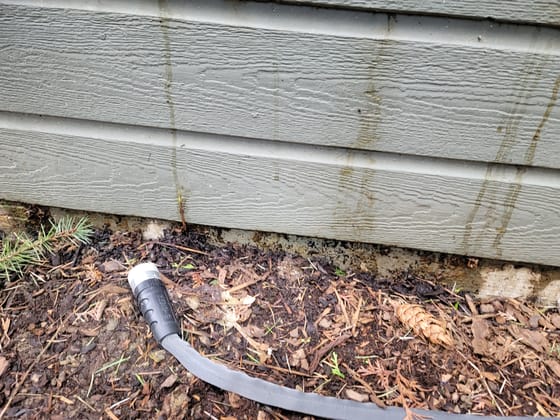
The residual perimeter treatment that would be routine around a foundation a mile inland is not the right approach against a canal bank, and the reason is straightforward: what goes on the ground near water eventually reaches the water. So along the canal edge the work moves to enclosed, secured stations, to trapping, and to physical exclusion of the structure itself.
That is not a reduced service. For rodents, closing the route and removing the individuals is more durable than treating a surface they cross, and the water constraint pushes the job toward the better method rather than away from it. What it does mean is that canal-side work is slower, more mechanical, and more about hardware than about product. If somebody has quoted you a quick spray along a canal bank, that is worth a second thought.
Salt, and what it does to a sealed building
Exclusion is the most durable pest control there is: seal an opening properly and it stays sealed. On the Point that has to be qualified.
Salt-laden air attacks precisely the materials exclusion depends on. Galvanized mesh corrodes from the cut edges first. Fasteners rust and lose purchase in whatever they are driven into. Door sweeps and weather seals harden, crack and pull back off the threshold. Flashing lifts as the fixings behind it go. And vent screening fails from the ground side, where nobody is looking.
None of that is a failure of the work. It is a waterfront building behaving like a waterfront building. The answers are stainless or coated hardware where it matters, materials chosen for the environment rather than for the price, and an honest expectation that exclusion here is maintained on a cycle rather than done once and forgotten.
We would rather quote a maintained result than promise a permanent one and be wrong in three years.
Damp underneath, on ground that drains well
Sand drains fast, and that leads people to assume moisture is not an issue here. Under a house on the Point it frequently is.
The water table on a low sand arm sits close to the surface and it moves with the season and the tide. Moisture wicks up through bare soil into a vented under-floor space, and marine air is humid most of the year, so that space has very little opportunity to dry out. On a property that stands empty for stretches, with no heating cycle and no air movement, it has even less.
That is how a house on well-drained sand ends up with the same softened rim joist, the same fouled insulation and the same fungal growth as a house in a wet inland valley — by an entirely different route. Growth like that needs nothing but moisture and time, which is the whole of the EPA’s explanation of why mold appears where it does.
A ground-contact vapor barrier over the soil is the single most effective thing on most of these properties. It is building work rather than treatment, it is not expensive, and it removes the condition that several other problems depend on.
Boats, and what winters inside them
A boat moored at the back of the house is a building nobody thinks of as a building.
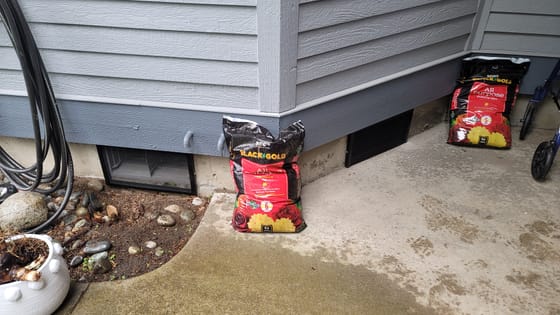
Laid up for the winter, a vessel contains upholstery, foam, insulation, wiring looms, canvas and frequently stored food, in an enclosed space that nobody opens for months, sitting a few feet from a bank full of cover. Rodents find that combination very quickly.
The damage is characteristic and it is expensive. Wiring gets chewed — frequently the loom rather than a single run. Foam and insulation get pulled out and packed into a locker or an engine space. Upholstery gets opened up. None of it is visible from the dock, and all of it is discovered in spring at the worst possible moment.
The work is simple and it is preventive. Remove anything edible before lay-up, including the things people forget — dry stores, pet food, bait. Open and check lockers rather than assuming. Place enclosed stations on the dock and around the mooring rather than product inside the vessel. And check in the autumn rather than reacting in the spring.
Storage sheds, garages and the gear that accumulates
Waterfront living generates equipment, and equipment needs somewhere to live.
Sheds, garages, dock boxes and lockers here hold crab gear, line, canvas, cushions, life jackets, fuel cans, tackle and everything else, and most of it is soft, undisturbed and only touched seasonally. That is nesting material of the highest quality, kept in a low, unheated structure close to the water.
Garages on the Point are worth particular attention because they connect directly to the house. A garage with a worn seal at the bottom corners of the door — which is nearly all of them within a few years, given what the salt does to rubber — is an open route into a building with a shared wall to the living space.
Checking storage first rather than last is the single change that shortens most jobs here.
Before you buy on the Point
People ask us what to look at before committing to a canal lot, and it is a fair question that nobody in this trade seems to answer directly.
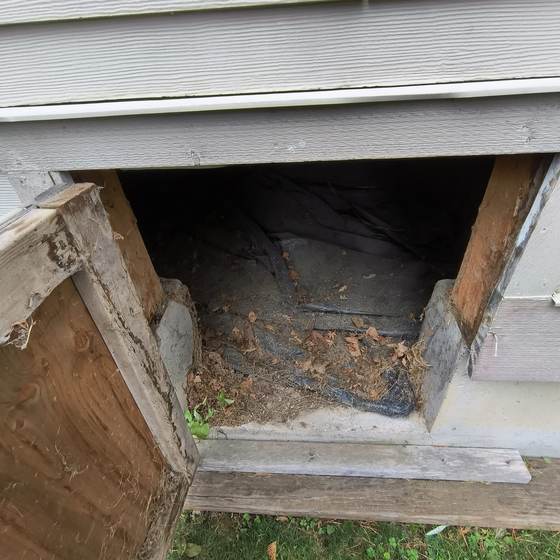
Get under the house. Not a look from the hatch, but into the space with a light. You are looking for whether there is a vapor barrier at all and what state it is in, whether the insulation is sagging or fouled, whether the framing near the perimeter has gone soft, and whether the vent screening is intact from the inside as well as the outside.
Look at the water edge as a structure rather than as a view. Bulkhead condition, what sits behind it, whether there are voids under a deck or a float, and what has been stored along the bank for the last decade.
Check the hardware. On a house that has stood here twenty years, the vents, sweeps, flashings and fasteners tell you whether anybody has been maintaining for this environment or simply replacing like for like with whatever was cheapest.
And ask when the crawlspace was last opened. On a property that has changed hands a few times the honest answer is often that nobody knows, and that is worth pricing in rather than discovering afterward.
The birds along the water
Shoreline and canal frontage attracts birds, and the pest consequence is usually not the birds themselves.
It is what accumulates. Nesting material in gutters and downspouts, which then holds water against the fascia. Droppings on decks and float structures. And, more importantly, the insects that live in an occupied nest and then move inward when it is abandoned — bird mites in particular, which turn up indoors weeks later and are routinely diagnosed as something else entirely because nobody connects them to a nest under an eave.
Much of what nests here is protected and the timing matters. Where there is an active nest we will say what can lawfully be done and when, and where the answer is that it waits, we will say that too.
Carpenter ants and beach wood
Carpenter ants are on the list for this whole shoreline, and here the source is frequently not a forest.
They do not eat wood — they excavate galleries in it to nest, and they take damp, softened wood far more readily than sound dry timber. Beach and canal wood that has been sitting wet for years is exactly that. So is old bulkhead timber, an aging dock frame, landscape ties, and a woodpile that has been against a fence since before anybody measured it.
The building end is the usual pattern: a parent colony outdoors sends satellite colonies outward, and a rim joist or a wall void suits a satellite as well as a log does. What is different here is how close the source can be, and how little it looks like a nest.
Carpenter ants and the damp wood they favor are explained plainly at Oregon State’s Solve Pest Problems, which is written for this corner of the country.
Practically, clearing accumulated wood and debris off the ground near the building is a real part of treatment on the Point rather than a suggestion, and it is not something we charge for saying.
Wasps under the eaves
Aerial nests do well here — soffits, eaves, boat houses, the underside of decks, and inside sheds that stand open all summer.
The complication specific to waterfront property is that a great deal of living happens outdoors between June and September, on decks and docks right where the nests are. A nest in a soffit above a deck is a different problem from the same nest on the back of a garage.
Bald-faced hornets build the large gray paper nests people photograph; European paper wasps build small open combs under railings, dock rails and window frames and are far less inclined to defend them. Yellowjackets in the ground along banks and verges are the ones that put people in an emergency room, because they are found by machine rather than by eye.
Honey bees we do not treat. If a colony has taken up residence in a wall we will identify it and point you at somebody who removes them properly.
Seasonal occupancy and the missing early warning
Some of the Point is lived in year-round and some of it is not, and the difference changes what a sensible service looks like.
An occupied house catches problems by accident. Somebody hears something in a wall, notices droppings on a counter, sees a wasp using the same gap every afternoon. None of that requires expertise; it requires a person being there.
Take the person away and nothing gets caught. A rodent that gets in during November is found in April, by which time it has bred, the insulation is fouled, and the opening it used has been enlarged by traffic.
For a part-year property, two scheduled visits do more than any treatment plan: one before it is closed up, to close the openings that are about to be used, and one before it is reopened, to find what got in while nobody was there.
Working on the Point, and the tax question
Sandy Point sits on the Sandy Point Arm, within the Lummi Reservation, and it is worth saying plainly that this is ordinary territory for us rather than somewhere we visit occasionally. We run it regularly.
There is one practical difference and it is worth raising before it turns into a surprise on an invoice: tax treatment on the reservation is not the same as it is off it. We are not the authority on your position and this page is not going to pretend otherwise — what it will say is that if you are having work done at an address out here, mention it when you book. It gets handled on the quote rather than corrected afterward, which is the way round everybody prefers.
Beyond that, nothing about the work changes. Same licensing, same products, same labels published on this site, same guarantee.
Access, and the practical business of getting to a lot
Finger lots on a sand arm are not always straightforward to work on, and it helps to know before we arrive rather than after.
Vehicle access can be tight, parking can be limited, and on some properties the crawl access, the storage and the water edge are a fair distance apart. Where material has to be removed — fouled insulation being the usual case — that distance is part of the job.
The community here also runs its own facilities and has its own arrangements. If there is a procedure for contractors, tell us what it is when you book and we will follow it rather than improvising at the entrance.
What we would rather you did not pay for
If the crawlspace is damp, the honest first answer is a vapor barrier rather than a treatment schedule, because most of what follows depends on the damp rather than on the season.
If the rodent route is a corroded vent or a garage seal, the honest answer is hardware. It costs a morning, it ends the route, and it does not repeat.
And if the problem is a bulkhead full of rats twenty feet from the house, no amount of work on the building alone will resolve it. The bank has to be part of the job, and where that involves a neighbor or the association we will say so and put it in writing.
We would rather tell you all three than sell around them.
A note on the tides
Work at the water edge is easier at low water, and where a job involves a bulkhead, a float or the ground beneath a dock we will try to time it that way.
How a visit works out here
We start at the water edge, because that is where the population usually is: bulkhead, rip-rap, dock and float structure, stored gear, and the vegetation along the bank.
Then storage — shed, garage, dock box, and the boat if it is part of the property.
Then the building at ground level: foundation line, vents and screens and what the salt has done to them, sweeps and thresholds, service penetrations, and the garage door corners.
Then underneath, with a light, through the whole under-floor space rather than a look from the hatch, checking the vapor barrier and the state of the insulation.
You get a plain account of what is active, what is historic, what is driving it, what is building work rather than pest work, and what should be done before the property is next left empty. Nothing is charged for the visit itself apart from bed bug verification, whose fee is taken off the treatment. We do not ask anybody to sign up to a term.
Frequently asked questions
Can you treat right up to the canal?
Not with everything, and the limits are there for good reason. Product that would be routine around a foundation inland is not appropriate against open water, so canal-side work leans on enclosed stations, trapping and physical exclusion instead. For rodents that is the more durable approach anyway, so it is not a compromise — it is just slower and more mechanical.
Why do the vent screens keep failing here?
Salt air, and no distance from it. Galvanized mesh corrodes from the cut edges, fasteners rust and lose their grip, and sweeps and seals harden and pull away. It is progressive rather than sudden, so nothing looks wrong until something is using the gap. Stainless or coated hardware is worth the difference here in a way it is not five miles inland.
Something is living under the dock or the bulkhead. Is that our problem?
It becomes yours when it moves the twenty feet to the house, which it will. Rip-rap, bulkhead voids and the space under a dock or a float are excellent rat harborage — dry, sheltered, undisturbed and impossible to see into. It is one of the first places we look when a canal-lot rodent problem does not add up.
The boat has been laid up all winter. Should it be checked?
Yes, and before you get in it in spring rather than after. An unattended vessel with upholstery, insulation, wiring and any stored food is very good habitat, and the damage found in April is routinely to a wiring loom. Ten minutes in October is worth a great deal more than a discovery in April.
Our crawlspace is damp and the roof is fine. Why?
Because on low ground near water the moisture is coming up rather than in. A high water table wicks through bare soil and a vented under-floor space over damp ground stays damp regardless of the roof. A ground-contact vapor barrier addresses that; guttering does not.
We are only here part of the year. What should we do?
Have the property looked at before you close it up and again before you come back. An unoccupied building has no early warning — nobody hears anything in a wall — so a problem that starts in November is found in April with five months of development behind it.
Is there a charge for an assessment?
Only bed bugs carry a fee, and it is a verification charge that comes back off the treatment. Out here the assessment should cover the under-floor space, any storage and the water edge of the lot, because those three account for most of what we end up dealing with.
Pest problem in Sandy Point?
Family-owned, no long-term contracts, and every treatment is backed by our 100% Service Guarantee.
Most calls in Whatcom County are out within 1–2 days, about 3 during the late-summer peak.
Last updated