
Pest Control Services in Bellingham & Whatcom County
Sasquatch Pest Control handles rodents, ants, spiders, wasps, bed bugs, termites and exclusion work for homes and businesses across Whatcom and Skagit County. Every service is family-owned and locally run, with no long-term contracts and a 100% Service Guarantee behind each treatment we perform.
Call 360-410-2199 Request a free inspection
Rodent Control & Exclusion
Stinging & Flying Insects
Household Bugs & Insects
Termite & Structural Pests
Exclusion, Repairs & Restoration
Commercial Pest Control
Why pest pressure works differently here
Most pest advice you will read online was written for a climate that has a hard winter. Ours does not. The marine air coming off Bellingham Bay keeps us mild and wet through most of the year, and the absence of a sustained deep freeze means populations are never reset the way they are east of the Cascades or across the Midwest. A rodent population that would be knocked back by a January cold snap in Spokane simply carries on here.
The second factor is moisture. Roughly thirty-five inches of rain a year, spread across a long gray season rather than delivered in summer thunderstorms, means wood stays damp. That single fact drives more of our call volume than anything else. Dampwood termites need wet wood. Moisture ants need wet wood. Carpenter ants prefer to excavate wood that has already begun to soften. Silverfish, sowbugs and millipedes all want humidity. When we get called to a Whatcom County house for any of those, the honest first question is not which product to use — it is where the water is coming from. Damp is a measurable condition rather than an impression: the USDA Wood Handbook puts the moisture content at which decay fungi can work at around twenty percent.
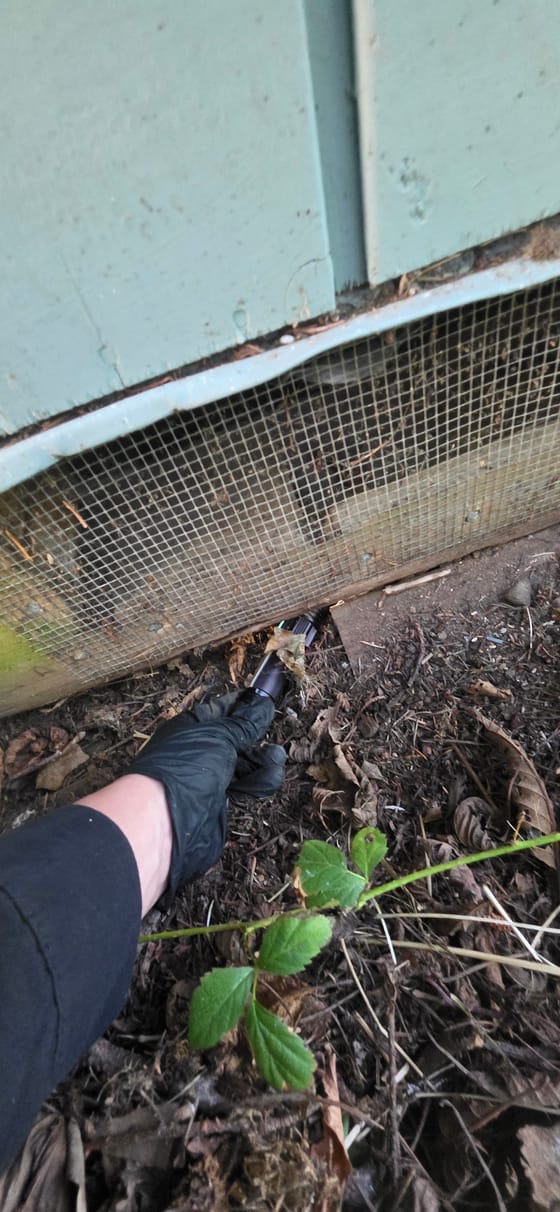
That is why our service list is organized the way it is above, and why exclusion and crawlspace work sit alongside treatment rather than as an upsell. Treating an ant trail without finding the leak that softened the sill plate means treating the same trail again next spring.
How we work
Every job starts with someone looking at the actual structure. We are trying to establish three things: what the species actually is, how it is getting in, and what is making the site attractive in the first place. Identification matters more than most people expect. Moisture ants and carpenter ants call for genuinely different responses, and the treatment that works for one is close to wasted on the other.
From there you get a written scope before anything begins, so you know what is being done and what it costs rather than finding out afterwards. There is no charge for the estimate, and there is no long-term contract. If a recurring program is the right answer we will say so; if a single visit solves it, we will say that too.
Work is done by our own technicians, who live here and run these routes themselves. We are not a franchise dispatching from another region, and the person who sets our standards works in the field rather than at a corporate office in another state.
What we will tell you honestly
There are jobs we turn down. We do not sell mole trapping, because the scissor-jaw and harpoon traps sold for that purpose are prohibited body-gripping traps under Washington law, and we would rather explain that than take the money. We do not do bird work or nuisance wildlife removal — that includes bats and squirrels — so if that is what you need we will say so on the phone and point you somewhere useful rather than taking the booking.

We also will not tell you a pest is dangerous when it is not. Hobo spiders are the clearest local example — Washington's Department of Health states that they are not considered dangerous as previously thought, and most of the large spiders people find indoors here in autumn are actually giant house spiders going about their business.
Seasonal timing in Whatcom County
Some work is worth booking ahead of the season rather than during it. Structural exclusion belongs in late summer, when crawlspaces and ground are dry and the autumn rodent movement has not started. Wasp and hornet colonies are largest and most aggressive in late August and September, but the cheapest time to deal with a site that had a nest last year is early summer. Rodent pressure climbs sharply as the rain sets in through September and October, and overwintering insects — cluster flies, boxelder bugs, conifer seed bugs — arrive on south-facing walls in October. Bed bug calls spike in January, after holiday travel.
What treatment actually costs, and why we won't publish a price list
A one-bedroom condo with a single ant trail and a 1920s farmhouse with rats in the crawlspace are not the same job, and any company publishing one price for "pest control" is either quoting the easiest possible version of the work or planning to revise the number once they arrive. We quote from a site visit, in writing, before anything starts, and the estimate is free.
The exception is bed bug work, where we do publish figures because the scope is genuinely predictable: a verification inspection, then a flat rate per room with common areas included. Where we can be specific we are.
What drives cost on most other jobs is access and structure rather than the pest itself. A crawlspace you can stand up in is cheaper to work than one with eighteen inches of clearance. A two-story soffit needs equipment a single-story one does not. Exclusion on a house with intact siding is straightforward; exclusion on a house where the siding has been soft for a decade turns into repair work, and we would rather tell you that at the estimate than halfway through.
Treatment, exclusion and repair are one conversation
A large share of what gets sold as pest control in this county is really building maintenance that has been deferred long enough for something to move in. An unscreened foundation vent, an open soffit return, a gap where a roofline meets a wall, a gutter that has been overflowing against a sill for three winters. Treating around those makes the problem quiet for a season. Closing them ends it.
That is why exclusion, crawlspace restoration and attic insulation sit in the list above alongside treatment services rather than being sold separately afterwards. On most Whatcom County houses the exclusion hour is the highest-value hour we spend on the property.
Frequently asked questions
What pest control services does Sasquatch offer?
Rodent and mouse control, exclusion and structural repairs, ants and carpenter ants, spiders, wasps and hornets, bed bugs, cockroaches, fleas, termites and wood-destroying pests, nuisance wildlife, plus exclusion, crawlspace restoration and attic insulation work.
Do you require a long-term contract?
No. We do not lock customers into long-term contracts. Recurring plans are available for people who want scheduled visits, and they can be canceled under the terms on our guarantee page.
What areas do you serve?
Bellingham and the surrounding Whatcom County communities, including Ferndale, Lynden, Blaine, Birch Bay, Everson, Nooksack, Sumas and Sudden Valley. Coverage detail for each community is on our service areas page.
Pest problem in Whatcom County?
Family-owned, no long-term contracts, and every treatment is backed by our 100% Service Guarantee.
Most calls in Whatcom County are out within 1–2 days, about 3 during the late-summer peak.