Choosing a pest control company feels like it should be simple. You have a problem, someone fixes it, done. But anyone who has hired the wrong pest control company — paid for ineffective treatment, signed a contract they couldn’t escape, or watched a problem get worse after someone told them it was handled — knows it’s not that simple at all.
The pest control industry has a mixed reputation, and not without reason. It includes some of the most knowledgeable, trustworthy service professionals you’ll ever work with, and it also includes companies that rely on fear, inflated diagnoses, and aggressive sales tactics to drive revenue. Learning to tell the difference before you hire protects your home, your wallet, and your time.
This guide gives you the complete framework for evaluating any pest control company in Whatcom County — the criteria that matter, the questions to ask, and the answers that should give you confidence versus the answers that should send you elsewhere. We wrote it knowing full well that some readers will use it to evaluate us. That’s exactly the point.
Why This Decision Actually Matters
The stakes are real. Pest control involves licensed chemicals applied to the place where you live, sleep, and feed your family. An undertrained or careless technician can cause harm. A poorly executed treatment can scatter pests to new areas, create resistance in pest populations, and cost you more in the long run.
Pest problems compound. The longer an infestation goes unaddressed — or is addressed ineffectively — the more entrenched and expensive it becomes.
You may be inviting them back regularly. Unlike a plumber who fixes a pipe and leaves, many pest problems require ongoing professional involvement. If you hire someone you don’t trust, you’ll be living with that choice for a long time.
Data from the Pacific Northwest is specific. What works for pest control in Southern California or Texas doesn’t necessarily apply here. The pest species, the climate, the housing stock, the moisture conditions — all of these are different in Whatcom County.
The 8 Criteria for Evaluating a Pest Control Company in Bellingham, WA
1. Licensing and Certification
This is the non-negotiable starting point. In Washington State, pest control applicators must be licensed by the Washington State Department of Agriculture (WSDA). Every company performing pesticide applications must hold a valid Pest Control Operator license, and every technician applying pesticides must hold a valid Commercial Pesticide Applicator license in the appropriate categories.
How to verify: You can check pesticide applicator license status through the WSDA online license lookup. Any reputable company will provide their license number immediately when asked. Hesitation or evasion on this question is a serious red flag.
2. Genuine Regional Experience
Pest control is local. The pest species present in Whatcom County, the timing of their seasonal activity, the moisture conditions specific to Western Washington, the housing types common to Bellingham — all of these require specific regional knowledge that a national franchise technician who trained in Texas or Georgia simply doesn’t have.
Questions to ask:
– How long have you been operating in Whatcom County specifically?
– What are the most common pest problems you treat in this area?
– How does the Pacific Northwest climate affect your treatment approach?
3. Transparency About Treatment Methods and Materials
You have the legal right to know what pesticides are being applied to your property. A responsible pest control professional should be able to tell you the specific products being applied, the active ingredients, why that approach was chosen, what precautions to take, and the expected duration of effectiveness.
Integrated Pest Management (IPM) is the gold standard approach. It prioritizes prevention, monitoring, and targeted treatment over broad chemical application, addressing the root causes of pest problems — entry points, harborage areas, moisture conditions, food sources — rather than just treating symptoms.
4. The Inspection Process
A thorough inspection is the foundation of effective pest control. A thorough residential inspection typically takes 45 minutes to 2 hours and should include the exterior perimeter, the crawl space, the attic, the interior, and structural entry points. It should produce a written report of findings — not just a verbal summary.
Red flags in the inspection process:
– Inspections that take less than 20 minutes
– Failure to inspect the crawl space
– No written documentation of findings
– Recommendations made before the inspection is complete
5. Contract Terms and Service Guarantee
The best pest control companies don’t need long-term contracts to keep customers — they keep customers with good work. If a company is pushing you hard toward a 12-month or 24-month commitment with cancellation penalties, ask yourself why.
Key contract questions: Are there cancellation fees? Are there skip fees? What happens if the treatment doesn’t work — is retreatment included? What exactly triggers the service guarantee? Is there a minimum commitment period?
6. Reviews and Local Reputation
In a service industry, reputation is everything. Look beyond the star rating to the actual content of reviews — specific mentions of technician names, whether the problem was actually solved, feedback on communication and follow-through, and how the company responds to negative reviews.
Platforms to check: Google Business Profile (most important), Yelp, Nextdoor, Facebook, and HomeAdvisor / Angi.
7. Communication and Professionalism
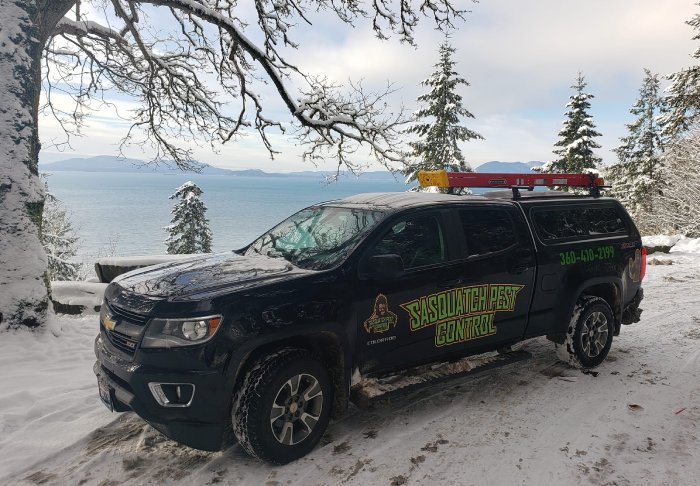
You can learn a significant amount about a pest control company from your first interaction. Signs of a professional operation include calls answered promptly, clear and direct answers, willingness to provide licensing information and written quotes, technicians who arrive on time in marked vehicles, and proactive communication about what was done and found.
8. Value, Not Just Price
The right question isn’t “who’s cheapest?” — it’s “who provides the best value?” A service that costs $150 and solves your problem completely is infinitely better value than one that costs $75 three times and leaves you with the same problem. Does the problem get solved? Does the solution last? Is the pricing transparent and fair? Is the treatment appropriate for the actual problem?
The Questions You Should Ask Every Pest Control Company Before Hiring
Licensing and credentials:
1. What is your Washington State Pest Control Operator license number?
2. Are your technicians individually licensed commercial pesticide applicators?
3. In what categories are they certified?
Experience:
4. How long have you been operating in Whatcom County?
5. What are the most common pest problems in this area?
6. Who will be performing my inspection and treatment — and what is their experience?
Inspection process:
7. How thorough is your inspection, and will you inspect my crawl space?
8. Will I receive written documentation of your findings?
9. How long will the inspection take?
Treatment approach:
10. What specific products do you use, and can you provide safety data sheets?
11. Do you practice integrated pest management?
12. What non-chemical options exist for my situation?
13. What precautions should my family take?
Business terms:
14. Do you require a contract? If so, what are the cancellation terms?
15. Are there skip fees or service deferral fees?
16. What does your service guarantee cover, exactly?
17. What happens if the pest returns before my guarantee expires?
Pricing:
18. Can you provide a written quote?
19. What’s included in that price, and what might result in additional charges?
20. Is the inspection free, and if not, is it credited toward treatment?
Why We’re Telling You All This
We’re a pest control company. We want your business. So why are we giving you a roadmap to evaluate every pest control company in Whatcom County, including us? Because we built Sasquatch Pest Control on a specific belief: that honest, transparent service is both the right way to do business and, ultimately, the most successful way to do business. When you apply every criterion in this guide to every pest control company in Bellingham, including Sasquatch, we’re confident you’ll feel good about working with us.
Frequently Asked Questions: Choosing Pest Control in Whatcom County
How do I verify a pest control company’s license in Washington State?
You can verify any pest control operator license through the Washington State Department of Agriculture (WSDA) online license lookup system at agr.wa.gov. Every company applying pesticides commercially in Washington must hold a valid license.
Should I get multiple quotes before hiring a pest control company?
Yes, particularly for larger or more complex jobs (full rodent exclusion, termite treatment, commercial bird exclusion). For a single, straightforward service call, multiple quotes may not be necessary.
Is it better to hire a local pest control company or a national chain?
Both models have advantages. Local companies often have deeper regional expertise and more direct accountability. The most important factors — licensing, experience, transparency, service guarantee — apply to both. Evaluate each company on its own merits rather than company size.
What should I do if I’m unhappy with a pest control company’s work?
First, contact the company directly and document your concerns in writing. If the issue isn’t resolved, you can file a complaint with the Washington State Department of Agriculture, which regulates pest control operators.
Start With a Free, No-Pressure Inspection
The best way to evaluate Sasquatch Pest Control is to experience us firsthand — and our 100% free inspection is exactly that opportunity. There’s no commitment, no contract, no obligation. Call us at 360-410-2199 or request your inspection online. We’ll answer every question in this guide — and then some.
Sasquatch Pest Control is a licensed pest control operator serving Bellingham, Ferndale, Lynden, Blaine, Burlington, Mt. Vernon, Sedro-Woolley, Everson, Sumas, Nooksack, Bow, Birch Bay, Sudden Valley, Lummi Island, and all of Whatcom County, Washington.
Sasquatch Pest Control offers honest, local, no-contract pest control — backed by our 100% service guarantee.
Get a Free Quote